
Objective movement analysis has always lived in the lab. The gold standard is optical motion capture — reflective markers worn on the body and tracked by a rig of synchronized cameras. It's remarkably accurate, but it needs markers, a calibrated multi-camera setup, a controlled space, and a trained operator — which puts it out of reach for almost every coach and athlete on the planet.
More recently, markerless systems have emerged as a capable alternative: still multi-camera, but no markers and no suit — you simply film the athlete. Theia3D, the system we benchmark against here, is one of the leading examples. Coach Brain takes the idea a step further: markerless, from a single ordinary camera.
That raises the obvious question: how much accuracy do you give up going from a multi-camera system to a single phone — and does it still tell you anything useful?
So we put them head to head: the same elite discus throws, captured at the same moment by both systems, compared joint by joint.
Accurate where it counts
Let's be upfront: a single phone camera is not as precise as a multi-camera system, and we're not claiming it is. For force-plate research or clinical certification, marker-based optical capture remains the gold standard, and it should be.
But that's not the question that matters for coaching. The question is:
Is single-camera capture accurate enough to produce the metrics and insights that actually help an athlete improve?
Joint angles. Ranges of motion. The timing and sequencing of a movement. How the body loads and unloads through a throw. That's the language coaches work in — and our test was designed to find out whether Coach Brain captures it faithfully enough to be genuinely useful. The short answer: yes. At a glance:
| What we measured | Agreement with the nine-camera system |
|---|---|
| Joint angles | r ≈ 0.92 average correlation |
| Whole-body posture | ~6 cm, averaged across every joint |
| Release speed | within ~0.5 m/s on most throws |
| Core (hip) rotation | r ≈ 0.97 · ~900°/s peak matched |
The test
We used five throws from elite men's discus (64–74 m) — and that choice matters, because discus is about as hard as markerless capture gets. The athlete spins through roughly one and a half turns, the whole body rotating and travelling across the ring, with the throwing arm whipping out and briefly hidden behind the body at release. Each throw was captured simultaneously by Coach Brain (one camera) and Theia3D (nine cameras) at 120 frames per second. We then aligned the two skeletons in 3D, synchronized them to within a fraction of a frame, and compared them frame by frame — joint positions, joint angles, and movement speed.
And Theia3D, being markerless itself, is an estimate rather than marker-based ground truth — so we report the results as agreement between the two systems, which is the fair way to frame it.
A quick note on what Coach Brain needs. When the camera details are known — an iPhone's lens parameters, or even its LiDAR depth — it uses them directly; when they aren't, it estimates the camera straight from the video. Either way, it also uses the athlete's height, which anchors the reconstruction to real-world scale so the measurements come out in true units. This study used the harder path — plain archival footage with no camera data, so Coach Brain estimated the camera itself, given only each athlete's height — and it still tracked the nine-camera system closely.
The movement signals that matter line up
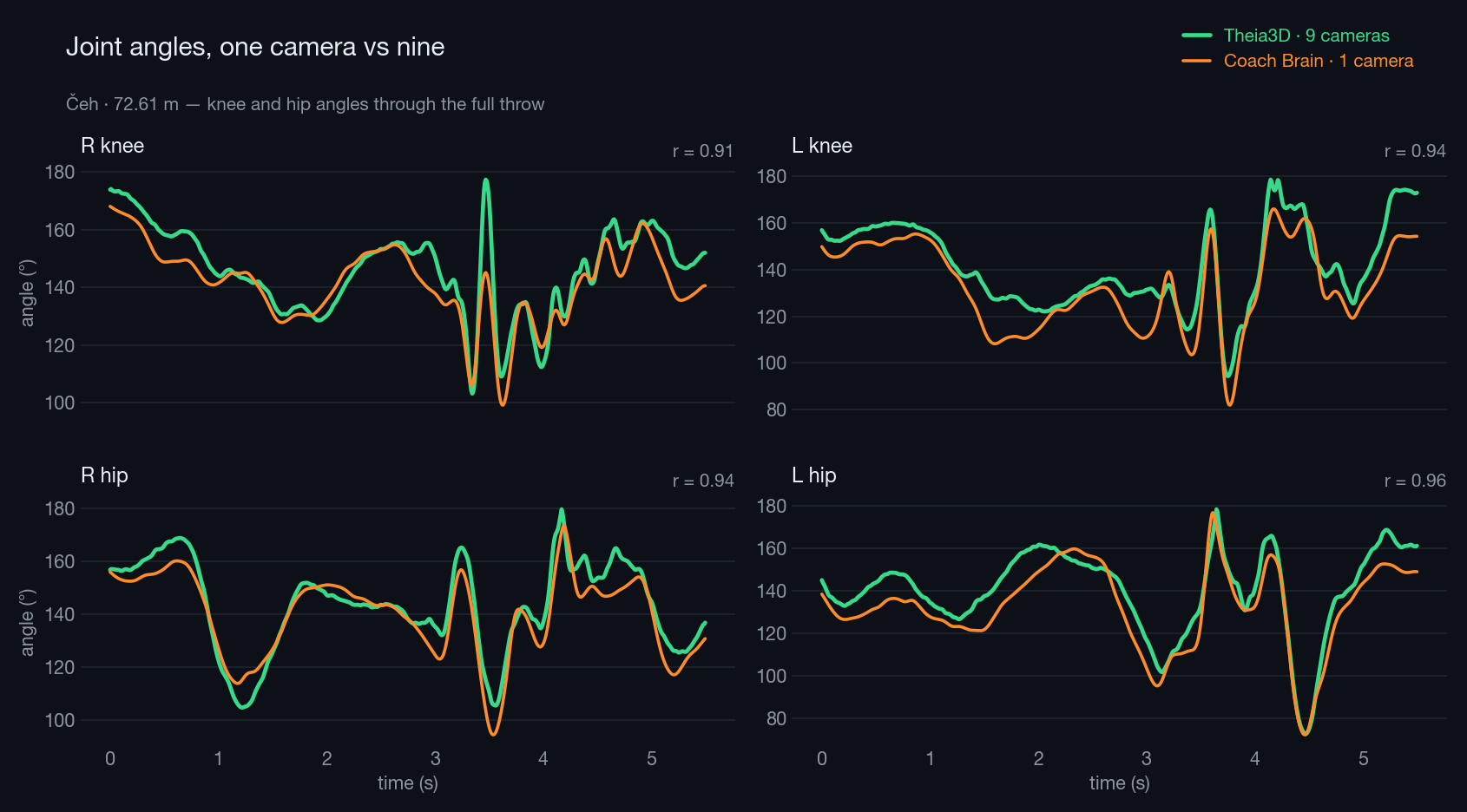
The clearest result is in the joint angles — the core of technique analysis. Across the whole throw, Coach Brain's joint-angle curves track the nine-camera system closely, with an average correlation of r ≈ 0.92.
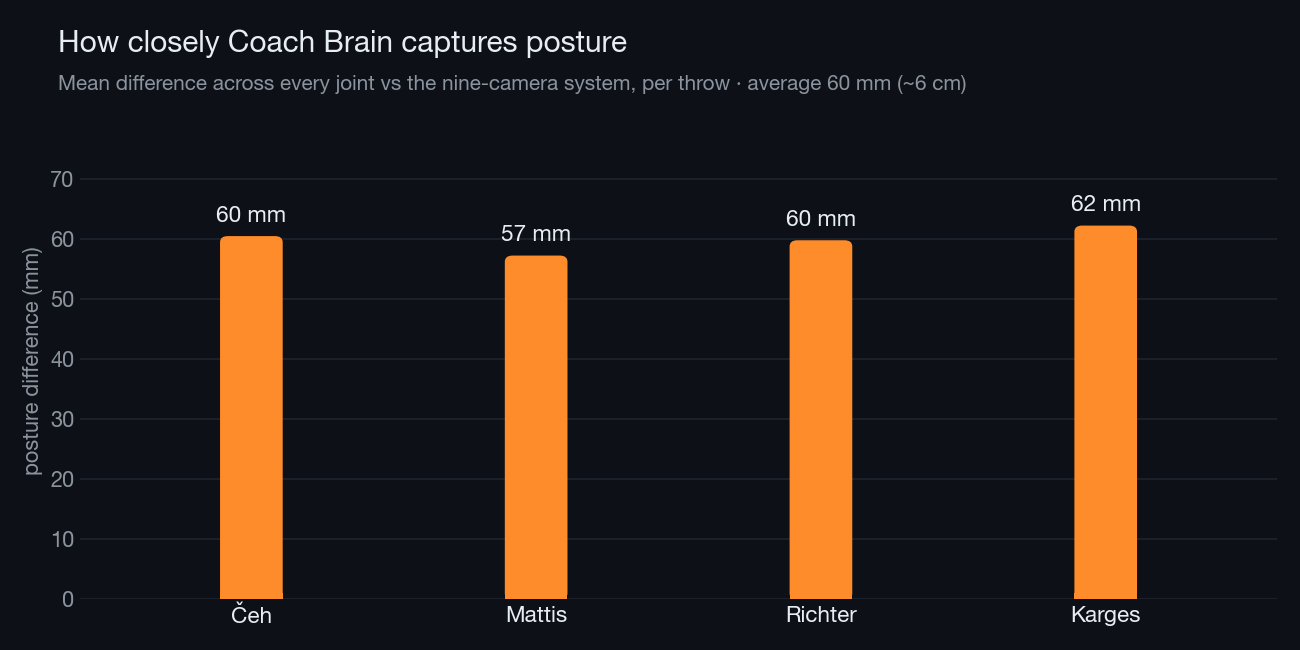
At the whole-body level, Coach Brain's joint positions land within about 6 cm of the nine-camera system — and that's the average across every joint in the body, the fast, occlusion-prone wrists at release included. The joints that drive technique — hips, knees, shoulders — are tighter still; it's the hardest distal points that pull the average up. So ~6 cm isn't a best case, it's the whole-body average.
Speed and rotation, in real-world units
Angles and positions are only half the story — coaches also care about speeds, and speeds need true scale. Coach Brain gets it from the athlete's height: anchoring the skeleton to a known height puts the whole reconstruction in real-world units, so its numbers are directly comparable to the nine-camera system, not just relative curves.
Start with the speed of the throwing hand — including the explosive acceleration into release — which follows the nine-camera system through the entire delivery.
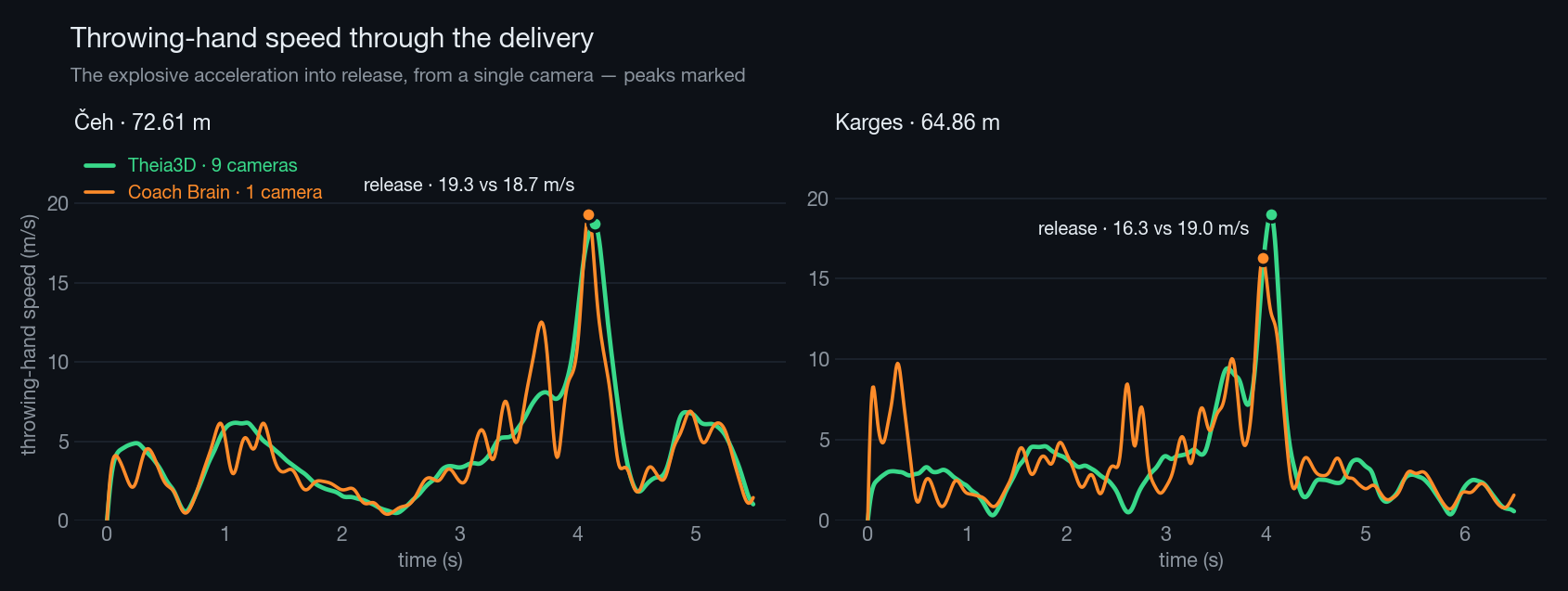
The number that decides the throw is release speed — how fast the hand is moving as the discus leaves it. Elite releases cluster around 18–20 m/s, and Coach Brain lands close on each: within about half a metre per second on most throws (Čeh 19.2 vs 18.6, Richter 19.2 vs 19.4, Denny 19.6 vs 19.1), and within a couple of metres per second on the rest. The launch direction — the release angle — agrees within a few degrees, too.
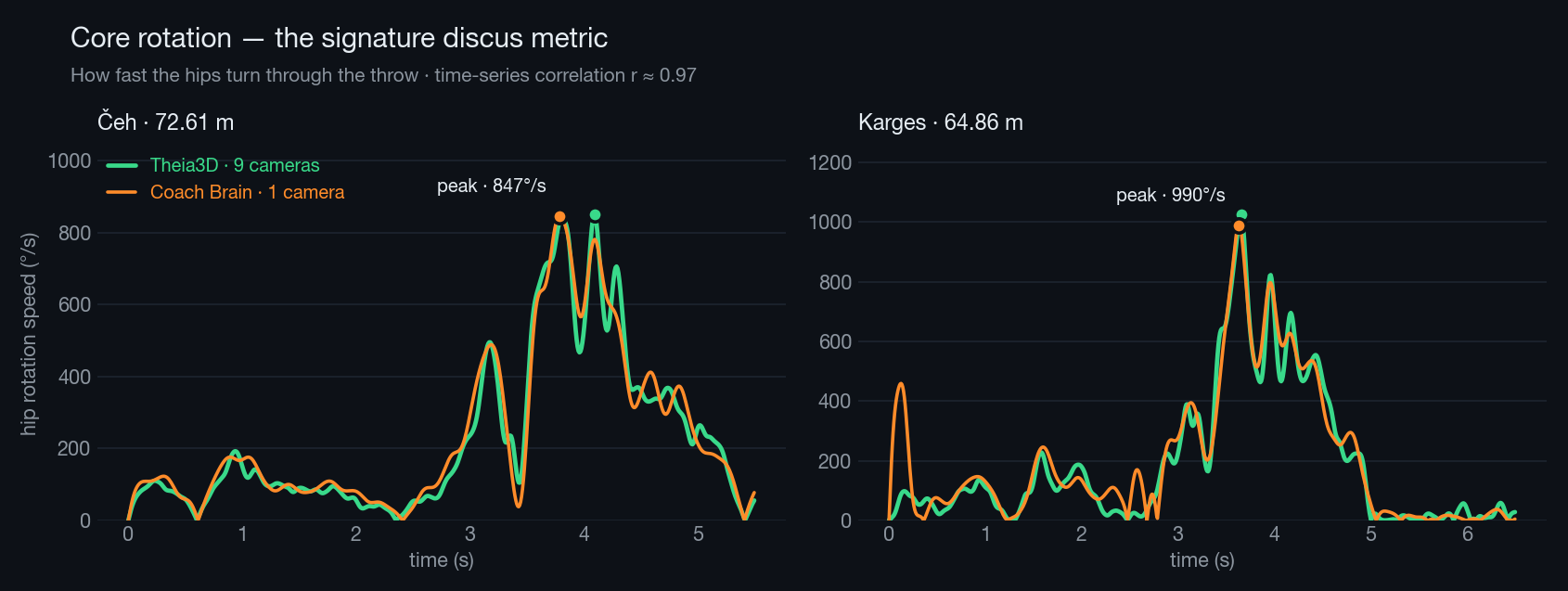
And because discus is a rotational event, how fast the core turns matters as much as the hand. Through the delivery the hips whip around at roughly 900°/s — about two and a half turns every second — and Coach Brain tracks that curve almost exactly, from the slow wind-up to the explosive peak (time-series correlation r ≈ 0.97 against Theia3D).
See it move
The best way to judge Coach Brain is to watch it move alongside the nine-camera system. Here both systems travel freely through space — orange is Coach Brain from one camera, green is the nine-camera system — and the trailing line traces the athlete's path across the ring.
Because Coach Brain estimates the camera, the two track closely through space, not just in shape. A single view still can't pin down absolute distance-from-camera perfectly, so there's a little residual wander — but it's small, and it doesn't affect the metrics that matter: joint angles, ranges of motion and the speeds above all depend on the body's shape and scale, not on exactly where it stands in the room.
What this means for athletes and coaches
Put together, the picture is clear. From a single ordinary camera, Coach Brain reconstructs movement faithfully enough to measure the things that inform technique — joint angles, ranges of motion, left-right asymmetries, and the timing and sequencing of a movement — and it tracks a professional nine-camera system closely on all of them.
It's not a replacement for a biomechanics lab, and it doesn't need to be. It's something arguably more valuable for the day-to-day work of getting better: objective, validated movement analysis that fits in your pocket and works anywhere — the training hall, the field, the throwing ring — with no rig, no markers, and no lab.
That's the whole idea behind Coach Brain: take the kind of analysis that used to require a university lab, and put it in the hands of every athlete and coach.
Validation study: Coach Brain vs Theia3D (9-camera markerless), five elite men's discus throws, 120 fps. Figures show agreement between the two systems.